Brief introduction
Multi-physics Fluid-structure Interaction Lab is dedicated to advancing high-fidelity numerical modeling of complex fluid-structure interaction phenomena, employing methods such as the immersed boundary method (IBM), lattice Boltzmann method (LBM), and gas kinetic scheme (GKS). Building on these numerical frameworks, the group investigates a wide range of fundamental physical problems and engineering applications.
Research directions
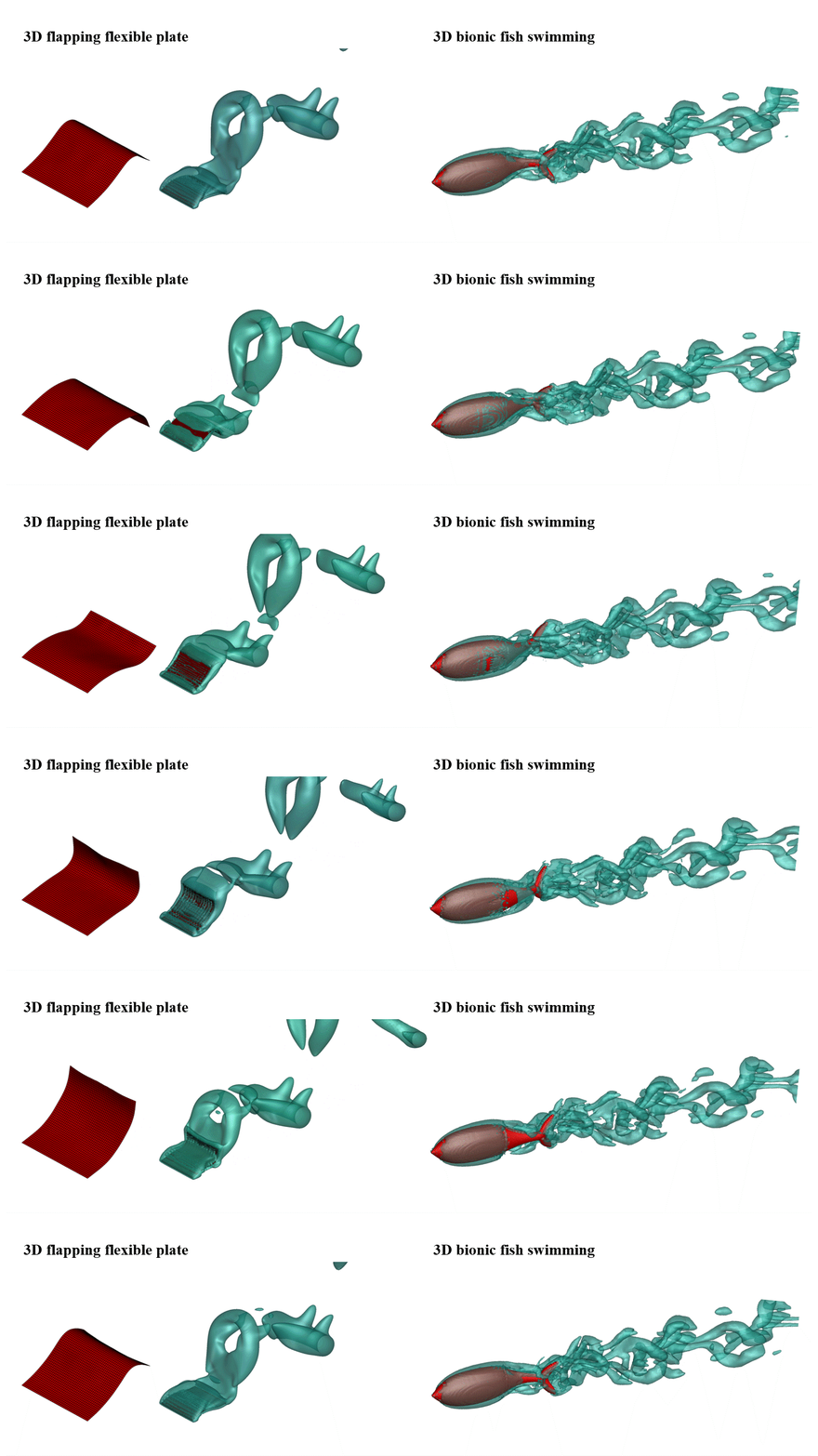
Isothermal Fluid-Structure Interaction
We develop an efficient isothermal fluid-structure interaction (FSI) numerical method: immersed boundary-reconstructed lattice Boltzmann flux solver (IB-RLBFS), which can simulate FSI problems with complex geometries, moving boundaries and large deformations.
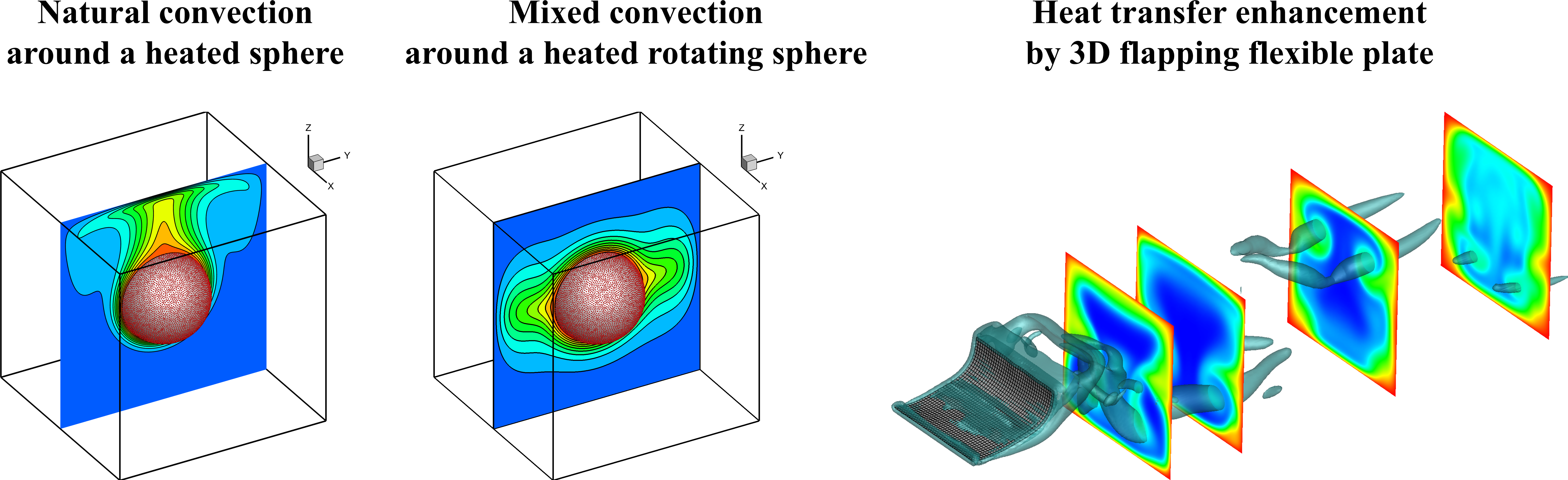
Thermal Fluid-Structure Interaction
We develop a thermal fluid-structure interaction (TFSI) numerical method: immersed boundary-reconstructed thermal lattice Boltzmann flux solver (IB-RTLBFS), which can simulate TFSI problems under complex thermal flows.
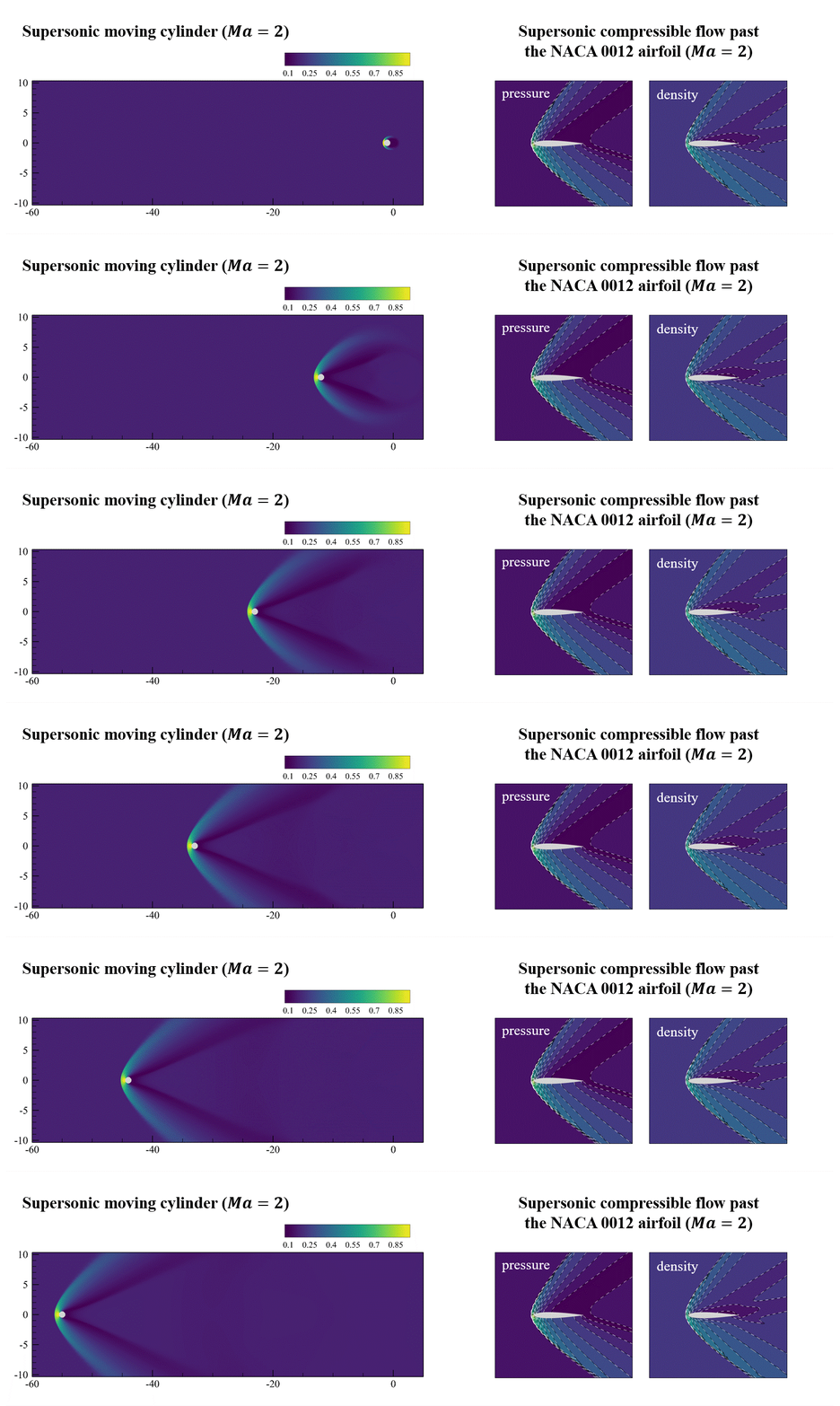
Compressible Fluid-Structure Interaction
We develop a compressible fluid-structure interaction numerical method: immersed boundary-gas kinetic flux solver (IB-GKFS), which can simulate FSI problems with moving boundaries and sharp geometries in a strong compressible environment.
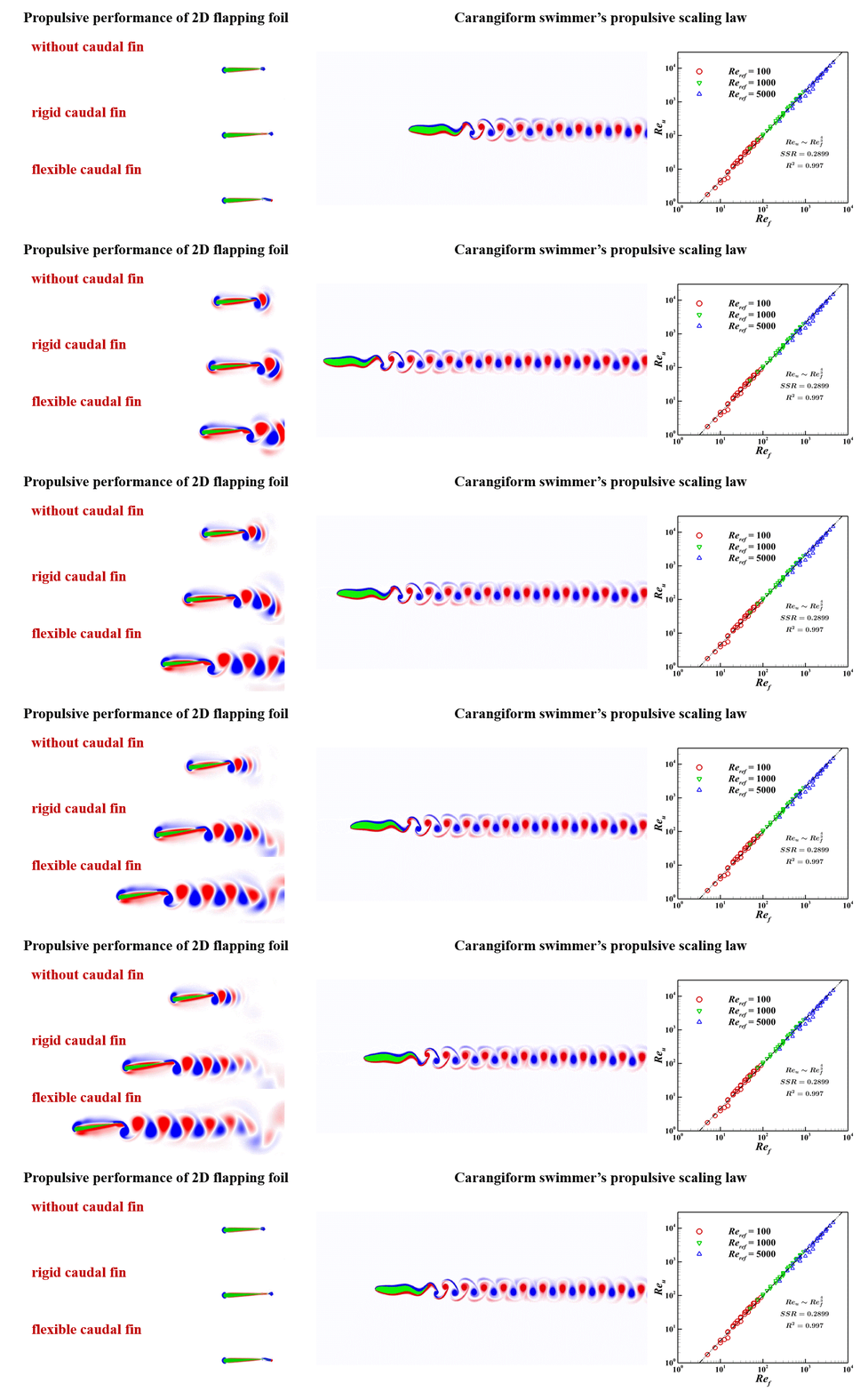
Propulsive performance of natural swimmer
Utilizing the developed FSI method, we investigate the effects of caudal fin's flexibility on the self-propulsive performance and the propulsive scaling laws of Carangiform swimmers.
Featured Publications
- Buchen Wu and Lin Fu* (2025). An implicit moving-least-squares immersed boundary method for high-fidelity fluid-structure interaction simulations. Journal of Computational Physics 530: 113913. [pdf][doi]
- Buchen Wu, Yaguang Liu and Lin Fu* (2025). One-side diffuse-interface immersed boundary method for compressible flows. Journal of Computational Physics 523: 113667. [pdf][doi]
- Buchen Wu, Yinjie Du and Chang Shu* (2025). Simplified inverse distance weighting-immersed boundary method for simulation of fluid-structure interaction. Journal of Computational Physics 521: 113524. [pdf][doi]
- Buchen Wu, Jinhua Lu, HsuChew Lee, Chang Shu* and Minping Wan* (2023). An explicit boundary condition-enforced immersed boundary-reconstructed thermal lattice Boltzmann flux solver for thermal–fluid–structure interaction problems with heat flux boundary conditions. Journal of Computational Physics 485: 112106. [pdf][doi]